As a facility manager or commercial building owner in Texas, you probably already face the challenge of maintaining a comfortable indoor climate under demanding conditions, but keeping the utility bills in check at the same time. The solution is no longer just a sophisticated HVAC system; it’s a fully integrated Building Automation System (BAS), also known as a Building Management System (BMS). This advanced Energy management system transforms your HVAC from a passive cost center into an intelligent, centralized, and high-performance asset.
Key Takeaways
|
What is Building Automation for Commercial HVAC?
Building automation is the seamless integration of your HVAC system and other crucial building processes (like lighting and security) with a central software platform.
Instead of relying on manual adjustments or rigid timers, the automated system uses a network of smart components to monitor, control, and optimize your environment in real-time.
This synergy creates a smart building control strategy, which ensures your facility uses the precise amount of energy needed. It also eliminates the substantial waste associated with traditional, manually controlled equipment.
Core Components of the Automation System
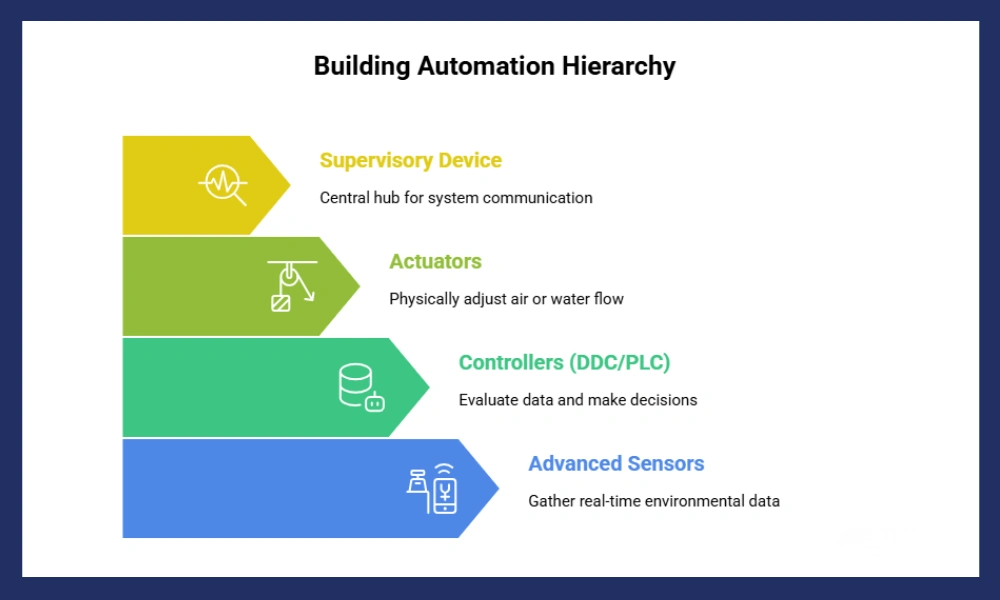
The success of building automation relies on four core elements working in harmony:
- Advanced Sensors: These gather real-time data on critical factors like temperature, humidity, occupancy, and CO2 levels throughout your facility.
- Controllers (DDC/PLC): These are the logic units (Direct Digital Control Systems or Programmable Logic Controllers) that evaluate sensor data and make intelligent decisions based on pre-engineered control sequences.
- Actuators: Actuators are the physical components, such as valves and dampers. They receive commands and physically adjust the flow of air or water to match the optimized settings.
- Supervisory Device/Network Controller: This acts as the “brain” or centralized hub, managing communication between all system components and providing the intuitive user interface for the facility management team. A simple Diagram often helps visualize this connection.
Key Technical Features Driving Energy Efficiency
HVAC automation is necessary because HVAC systems can account for 40–50% of a commercial building’s total energy use. Leveraging a BAS allows you to implement advanced HVAC control strategies, leading to significant savings. Here’s how:

1. Dynamic Scheduling and Optimal Start
The Optimal Start feature uses adaptive learning (often powered by AI algorithms now) to compare outside and indoor conditions. It activates the HVAC system in a deliberate, sequential manner only when necessary.
As a result, the building reaches the desired setpoint precisely before you start to occupy the space. This feature dramatically reduces unnecessary runtime and can deliver energy savings of up to 30% on scheduling alone.
2. Demand-Controlled Ventilation (DCV)
This is one of the most powerful features for efficiency. DCV utilizes CO2 sensors to measure the actual density of occupants in a space. It then automatically adjusts the amount of fresh outdoor air ventilation required by ASHRAE standards (ASHRAE 62.1, 90.1, and 55).
This ensures high indoor air quality while reducing the energy used to heat or cool excessive volumes of air. Studies show DCV can reduce HVAC energy usage by 30-60%.
3. Load Shedding and Peak Load Management
To manage high demand and avoid high utility surcharges, Load Shedding allows the system to temporarily cycle off non-essential HVAC equipment during peak utility demand times or when the energy management system detects high pricing. This ability to shift loads and take advantage of off-peak hours is crucial for operational cost control.
4. Advanced System Integration
A modern Automation system must be vendor-agnostic. The ability to integrate with existing and new systems is paramount.
- The Challenge: Many manufacturers use proprietary communication protocols.
- The Solution: Using advanced HVAC gateways and controllers that support open-source protocols like BACnet/MSTP or BACnet SC creates a unified interface, even across disparate VRF (Variable Refrigerant Flow) and traditional mechanical components.
- The Future: Integration with IoT technology and cloud-based platforms enhances real-time monitoring and enables remote access capabilities across multiple sites.
The Business Case: Measurable ROI and Benefits
Implementing Building management is a strategic investment that provides rapid and measurable return on investment (ROI). Total energy savings typically range from 15–30%, resulting in a payback period of typically 2–5 years.
| Benefit | Impact and Value |
| Maintenance & Longevity | Predictive maintenance strategies flag issues like clogged filters, overheating compressors, or failing blower motors early. This prevents catastrophic equipment failure, minimizes costly downtime, and extends equipment lifespan. |
| Occupant Comfort & Productivity | Precision Temperature Control and Intelligent Zoning eliminate hot or cold spots, ensuring consistent cooling and heating tailored to occupancy. This boosts employee and tenant productivity and well-being. |
| Financial & Operational | Lower utility bills, less physical work for the facility team (Workforce Optimization), and the opportunity to capitalize on government and utility incentives and rebates (tax credits, low-interest financing). |
| Sustainability & Compliance | Reduced energy consumption lowers the overall carbon footprint and helps facilities achieve sustainability goals, including LEED certification and adherence to GHG regulations. |
BAS Implementation from Texas Central Air
Whether managing a simplistic office building with VAVs or a critical environment like a data center or hospital, a strategic implementation is key.
- Consultation: Work with certified professionals who understand both HVAC control and building automation to perform a custom cost assessment and align the system with your operational goals.
- Installation: Opt for factory-installed controls whenever possible to simplify commissioning.
- Training: Ensure your technician and facility staff are trained on the user interface for monitoring, programming, and utilizing advanced analytics for continuous tuning and optimization.
For your commercial building in Texas, leveraging building automation systems is the most effective way to protect your investment, lower operational costs, and guarantee optimal comfort year-round.
Conclusion
The choice is clear: in today’s competitive and energy-conscious environment, a Commercial HVAC system is either an unavoidable cost or an intelligent performance asset.
By adopting a Building Automation System (BAS), you are moving beyond simple temperature control. You are implementing Smart building controls that leverage AI algorithms and IoT technology to provide real-time monitoring, enabling predictive maintenance and maximizing Energy efficiency.