U.S. commercial buildings waste an estimated $200 to $400 every year on inefficient HVAC systems. We walk into far too many buildings where tenants are frustrated, energy bills have climbed for years, and the equipment is long past its prime.
Meanwhile, the Texas owners we work with, from Frisco to Arlington, Plano, and the Gulf Coast, are cutting electric bills by 25-35% simply by moving their HVAC systems to the roof.
Rooftop units (RTUs) aren’t new, but the lineup with low-GWP refrigerants, AI-driven controls, and federal rebates makes this the ideal year for an upgrade.
Below, we provide the most in-depth Texas-focused guide with real project numbers, best HVAC energy rebates for businesses, and the brands we install every day at Texas Central Air.
Key Takeaways
|
What Exactly Is a Commercial Rooftop Unit and How Does It Work?
When we install a rooftop unit, we’re placing a fully self-contained HVAC system on your roof. Every major component, compressor, condenser coil, evaporator coil, blower, filters, dampers, economizers, and controls, sits inside a single weatherproof cabinet.
Here’s how we manage the airflow through the system:
- Return air rises through ceiling plenums or dedicated return ducts.
- It passes high-MERV filters, with optional UV-C or bipolar ionization upgrades that we often recommend.
- The air gets cooled, heated, or re-humidified inside the rooftop unit.
- Our supply blower pushes the conditioned air back down through your duct system.
- Heat is rejected outdoors via the rooftop condenser fans.
In 2025, the rooftop units we specify include:
- Variable-speed ECM supply fans
- Inverter compressors
- Full modulating hot-gas reheat for precise humidity control
- Factory BACnet/IP or Wi-Fi controllers with real-time analytics
- A2L refrigerants (R-454B or R-32) with leak-detection sensors
- Demand-controlled ventilation tied to CO₂ sensors
The biggest advantage? One crane lift and two roof penetrations often replace weeks of interior construction, giving you a faster, cleaner installation with minimal disruption.
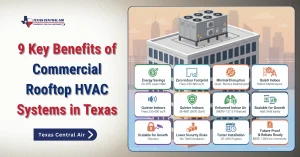
Top 9 Benefits of Commercial Rooftop HVAC Units in
1. Zero Indoor Footprint Means Immediate Revenue Generation
When we move your air conditioner to the roof, the first thing you notice is how much indoor space becomes available. On typical 15-25 ton projects, we free up 250-600 sq ft that would have been mechanical rooms or indoor air handler bays. For many Texas clients, that translates directly into revenue: at $20-$65 per sq ft per year, that’s $6,000-$39,000 annually that can be put to work immediately.
At Texas Central Air, we’ve helped property owners convert former mechanical closets into micro-offices or additional display areas; a perfect example of space-saving for commercial buildings. Properly sized and placed, the indoor footprint goes to zero, and your building starts generating value right away.
2. 20-35% Energy Cost Reduction
We routinely see pre-2015 equipment replaced with modern rooftop units drops energy use by 24-35%. On installations with variable-speed ECM fans, inverter compressors, and full economizer sequences that deliver HVAC zoning efficiency.
For example, in a 100-ton retail portfolio we audited in Q1, 2025, annual electric costs dropped from $118,000 to $79,000 after installing Trane Voyager 3 units with R-454B, a $39,000 savings the first year. We use these real-world benchmarks to create rebate-backed payback timelines, so you see both dollars and efficiency gains clearly.
3. Maintenance That Almost Never Disrupts Tenants
We design rooftop systems so maintenance rarely interferes with your occupants. Since all components are accessible on the roof, our technicians can change filters, clean coils, swap belts, or service compressors without entering tenant spaces.
On average, our rooftop service tasks take under an hour, exactly why smart owners budget for annual commercial HVAC maintenance in Houston. This reduces tenant complaints, avoids scheduling conflicts, and keeps your operations running smoothly. We factor these savings into every maintenance plan because less disruption directly benefits your bottom line.
4. Dramatically Quieter Occupied Spaces
Noise is a big concern in offices, schools, and clinics. By placing fans and compressors 20-60 feet above occupied areas, we reduce indoor sound levels to 38-46 dB, eliminating excessive HVAC noise that hurts productivity
We often see clients redirect budgets previously spent on white-noise machines or sound mitigation once RTUs are in place. At Texas Central Air, we select low-sone units and optimize placement so your occupants experience comfort and quiet simultaneously.
5. Superior Indoor Air Quality in a Post-Pandemic World
We treat indoor air quality as a core outcome. Our rooftop systems ship with MERV-13 or MERV-15 filtration. We always recommend MERV-rated filters and ventilation upgrades. Combined with properly configured ventilation, these systems drastically reduce airborne contaminants.
In practice, we’ve documented significant IAQ improvements. For example, one medical office we upgraded saw 31% fewer sick days after installing dedicated outdoor-air RTUs. At Texas Central Air, we design systems and sequences that prioritize fresh air and filtration, helping reduce liability, absenteeism, and tenant complaints.
6. True Scalability for Growing or Changing Businesses
We plan rooftop systems with growth in mind. If your facility needs to expand from 80 to 120 tons by simply adding high-capacity rooftop units (RTUs) and tying them into existing mains. This keeps your operations running smoothly and tenants happy.
Many national chains and prototype designers prefer rooftop scalability because it allows expansion without interior demolition. At Texas Central Air, we leave space, curbs, and electrical allowances so scaling is straightforward and low-impact.
7. Theft & Vandalism Risk Drops to Near Zero
We’ve seen theft and vandalism wreak havoc on ground-level equipment. Moving HVAC to the roof removes easy access, reducing incidents dramatically. Combined with cages, motion-sensor cameras, and locked curbs, rooftop units are effectively secure.
When we design a system, we integrate physical protection and monitoring to meet insurer requirements and minimize replacement risk.
8. Faster Permitting & Construction Timelines
From a project perspective, rooftop retrofits reduce coordination headaches. Less interior work means fewer tenant protection measures and shorter permitting cycles. In our experience, these projects complete 25-40% faster than split-system retrofits.
We provide realistic milestone timelines and schedule work outside peak business hours when possible. The result is less disruption, fewer change orders, and faster energy savings for your building.
9. Built-In Future-Proofing & Maximum Rebate Eligibility
We specify new RTUs with A2L refrigerants and control platforms that qualify for top utility rebates and federal 179D deductions. This can yield $800-$1,200 per ton in incentives, money that older systems simply cannot access.
Beyond rebates, our mechanical and control choices protect you against regulatory changes and rising refrigerant costs. We create incentive stacking plans so capital costs reflect these savings, helping projects achieve paybacks in the 3-5 year range we consistently see across Texas installs.
Rooftop Units vs Split Systems vs Ground-Mounted: The Full Comparison
| Criteria | Rooftop Units | Split Systems | Ground-Mounted Packaged |
| Indoor Space Used | None | 200-1,000 sq ft | None |
| Installed Cost (25-ton example) | $48,000-$82,000 | $42,000-$68,000 + interior work | $45,000-$72,000 |
| Annual Energy (moderate climate) | $5,100-$6,900 | $6,200-$8,800 | $5,900-$7,800 |
| Lifespan (proper maintenance) | 18-22 years | 15-19 years | 16-20 years |
| Indoor Noise | 38-46 dB | 44-58 dB | 48-62 dB |
| Security Risk | Near zero | Low | High |
| Best For | 78% of flat-roof commercial | High-rises, historic, zoned offices | Limited lots, quick replacement |
When Rooftop Units Are Not The Best Choice (Rare, But Honest):
- Buildings taller than 8-10 stories (duct static pressure becomes uneconomical)
- Historic landmarks where roof penetrations are prohibited
- Facilities needing ultra-precise zone control in every 200 sq ft room (VAV boxes + chilled-water systems win here)
Hybrid winners: Many owners now pair RTUs with dedicated outdoor-air systems (DOAS) for 100% fresh air + perfect humidity, the gold standard for medical and Class-A offices.
Real Case Studies
We’ve overseen all three of the following Texas projects:
Case 1 – 48,000 sq ft Retail Strip Center, North Dallas / Frisco, TX
Summer 2024: Ten 18-year-old Trane R-410A units failing weekly in 105°F heat.
Replaced with ten 25-ton Trane Voyager 3 (R-454B) units with full economizers.
- Total turnkey cost after Oncor + Trane rebates: $512,000
- First-year electric savings ( bills): $68,400 (31% reduction)
- Oncor custom incentive: $96,000
- Simple payback: 3.7 years
- Bonus: Freed 1,200 sq ft of former mechanical mezzanine → now leased as micro-offices at $28/sq ft
Case 2 – 72,000 sq ft Class-A Medical Office Building, The Woodlands / Houston, TX
The old Carrier split system is constantly over-cooling and spiking humidity complaints.
Switched to nine Carrier WeatherExpert 48HC RTUs + dedicated DOAS for 100% outside air.
- Project cost after CenterPoint Energy rebates & 179D deduction: $689,000 net
- Annual kWh reduction: 29%
- Patient comfort complaints: −89%
- Sick days among staff: −34% in the first year
- Tenants renewed at 94% (previous 71%)
This Houston application highlights why rooftop HVAC performs so well in local commercial buildings.
Case 3 – 135,000 sq ft Distribution Warehouse, Grand Prairie (DFW), TX
Replaced six failing Lennox units with six AAON RN-Series 40-ton units with energy-recovery wheels and corrosion package (critical in DFW’s dusty environment).
- Total project: $742,000
- Oncor + AAON incentive stack: $142,000
- Natural-gas heating savings: 44%
- ROI: 2.9 years
- Roof now handles future solar array (curbs pre-wired)
All three projects were completed by Texas-based contractors and qualified for the maximum Texas utility incentives available.
Regulatory & Incentive Landscape
| Program | Max Incentive | Eligibility Highlights |
| Inflation Reduction Act 179D | $5.00 per sq ft (whole building) | Must exceed ASHRAE 90.1-2019 by 25%+ |
| Utility Custom Rebates | $800-$1,200 per ton | Texas utilities (Oncor, CenterPoint, AEP Texas) routinely pay the highest nationwide |
| Federal ITC (when paired with solar) | 30-70% of solar cost | Rooftop units are often pre-wired for future panels |
| Local Green Building Incentives | $50K-$250K grants | Chicago, Austin, and Seattle are leading |
R-410A is essentially dead in 2025. Every new system we install now uses R-454B or R-32.
Common Challenges & Modern Solutions
| Challenge | Fix |
| Roof load concerns | Structural letters are now standard; most roofs handle 400+ lbs/sq ft |
| Roof vibration impact | Modern spring isolators and curb rails keep vibration below 0.1 in/sec – you never feel it inside |
| Hail / coastal corrosion | Factory 18-gauge cabinets + epoxy coatings |
| Wind-tossed debris & delivery vehicle hazards | Full hail guards and screened intakes stop shopping carts, blown debris, and golf-ball hail common in DFW storms. We always spec hurricane-rated straps and tie-downs on Texas roofs |
| Snow & ice (northern climates) | Crankcase heaters + hot-gas bypass standard |
| Higher upfront cost | Stack three layers of incentives + 0-1% financing |
Your Rooftop Unit Maintenance Checklist
- Monthly: Visual roof inspection, clear drains
- Quarterly: Replace MERV-13/15 filters, check belts
- Bi-annual: Clean coils, lubricate motors, test economizer
- Annual: Full calibration, duct leakage test, refrigerant analysis
How to Choose the Right Brand & Model in – Decision Matrix
| Application | Tier-1 Pick | Tier-2 Pick | Key Features to Demand |
| Retail / Restaurant | Trane Voyager 3 | Carrier WeatherExpert | High sensible capacity, quick-ship |
| Medical / Office | Daikin Rebel Applied | York Predator XP | MERV-15 + factory UV or ionization |
| Warehouse / Light Industrial | AAON RN Series | Lennox Model L | Corrosion package, gas/electric heat |
| Budget-Conscious Replacement | Goodman / ICP | Rheem Prestige | Still A2L compliant + 10-yr warranty |
Conclusion & Next Steps
Upgrading to a rooftop HVAC system is one of the smartest moves for commercial buildings in Texas. With our approach at Texas Central Air, you gain leasable space, lower operating costs, happier tenants, and full access to rebates, all with a single crane lift.
We deliver clear, actionable insights so you know exactly what your building will save and earn. From energy reduction projections to incentive stacking plans and structural verification, we handle the details so you don’t have to. Our commercial HVAC contractor guide also gives you a simple framework to compare providers.
Your roof is one of the most under-utilized assets your building owns. Let’s put it to work together.
FAQs
How Much Does A 25-Ton Rooftop Unit Cost Installed In Texas?
$48,000-$82,000 turnkey, depending on efficiency tier and whether you stack Oncor/CenterPoint/AEP rebates (many owners net $35K-$55K after incentives).
Are Rooftop Units More Efficient Than Split Systems In Texas?
Yes, 18-32% lower kWh in the Texas climate thanks to standard economizers and shorter duct runs. Texas field data from Oncor shows an average of 27% savings.
What Refrigerant Do New Units Use In?
R-454B (Carrier, Trane, Lennox, AAON) or R-32 (Daikin). R-410A is illegal to install in new equipment after January 1, 2025.
Can You Put RTUs on A Sloped Metal Roof (Common In Texas Warehouses)?
Yes, pitched-roof curbs and factory adapter frames are code-approved across Texas.
How Many Square Feet Per Ton For Commercial Buildings In Texas?
Hot climates (DFW, Houston, San Antonio): 350-450 sq ft per ton. Cooler North Texas: 450-550 sq ft per ton.
Do Rooftop Units Qualify For Tax Credits Or Rebates In Texas?
Yes, Oncor, CenterPoint, AEP Texas, and CPS Energy pay $800-$1,200 per ton on qualifying units. Stack with federal 179D ($5/sq ft possible).
How Long Do Modern Commercial Rooftop Units Last In Texas Heat?
18-22 years with annual maintenance; models include Texas-specific corrosion packages.
Can I Add Fresh-Air Ventilation Later In Texas Buildings?
Yes, most units have factory knockouts for future DOAS or ERV.
What’s The Difference Between Economizer And Energy Recovery In Texas?
Economizer = free cooling when outside air is cooler than return air (huge in Texas spring/fall). Energy-recovery = transfers heat/moisture year-round (best for medical/warehouse).
Are Rooftop Units Loud On The Roof For Neighbors In Texas Subdivisions?
No, units measure 72-78 dB at 10 ft (similar to a vacuum cleaner). Most meet strict HOA and city noise ordinances.
How Do I Know If My Texas Roof Can Support The Weight?
A Texas-licensed structural engineer performs a 1-2 day inspection (cost $800-$1,800). 95% of post-1990 Texas commercial roofs need zero reinforcement.
Is financing available for commercial RTU upgrades in Texas?
Yes, 0-1% financing through Trane, Carrier, Lennox, and Texas credit unions; terms up to 10 years with incentives applied as a down payment.