Managing a commercial property isn’t child’s play. No matter what the commercial property type is, cost control is always at the forefront. But this can be very challenging with traditional HVAC systems. Here, AI and IoT-integrated HVAC systems come into play. With the integration of these technologies, business owners can run day-to-day operations more efficiently and effectively. In this article, we have discussed how IoT-enabled HVAC units can benefit your commercial property and whether you should upgrade your HVAC system.
TL; DRBy enabling predictive maintenance, energy optimization, remote monitoring, and system integration, AI and IoT are transforming HVAC systems. Because of these advancements, homeowners and businesses can reduce operational costs significantly, improve the IAQ, and enhance overall comfort. |
Transforming the HVAC Industry: The Role of AI and IoT in Modern HVAC Systems
AI or Artificial Intelligence is computer systems performing tasks instead of humans like learning and decision-making. IoT or Internet of Things refers to interconnected devices collecting and exchanging data.
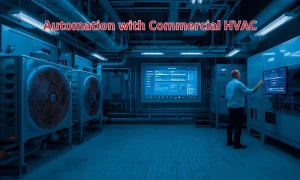
With traditional HVAC systems, homeowners and businesses often don’t have complete control. Besides, these units don’t provide any insight, not allowing optimization of operation. IoT-enabled HVAC units do the opposite. These units have sensors and other advanced features that enable all these and make the lives of property managers easier.
5 Key Benefits of AI and IoT for Your Commercial Property
1. Lower Operating Costs
- IoT-enabled HVAC systems have sensors and smart devices that ensure that the energy is only used when needed.
- More precise control allows a significant drop in the monthly utility bills.
2. Reduced Equipment Downtime
- These AI-powered HVAC units have predictive maintenance features that minimize the risk of sudden breakdown by addressing the core issue earlier.
- This feature allows property owners to make timely decisions and prevent expensive repairs or replacements.
3. Improved Indoor Air Quality
- AI monitors the IAQ of the space and adjusts the ventilation according to the demand.
- This feature is more suitable for sensitive spaces like healthcare centers or schools.
4. Enhanced Comfort and Productivity
- IoT and AI-enabled HVAC units ensure that the humidity level of the space remains at a good level.
- With a stable humidity level, customers and employees can feel at ease. It eventually boosts business and customer satisfaction.
5. Data-Driven Decisions
- These smart heating and cooling systems offer insights that traditional HVAC systems cannot provide, enabling data-driven decisions.
- With the correct data and insights, property managers can optimize the operation.
You can explore Commercial HVAC Service in Houston like Texas Central Air to learn more about how upgrading to an IoT-enabled HVAC unit can optimize your commercial real estate and its operation.
Challenges and Considerations
AI and IoT upgrades are not without their drawbacks. Here are some challenges:
· Initial Costs
Upgrading to a smart HVAC unit requires a higher initial cost. However, you can consider it as an investment that will outweigh the initial expenses in a short span.
· Data Security
Connected systems rely on internet access, which introduces potential cybersecurity risks. To mitigate this risk, you’ll have to choose a trusted provider.
· Complexity
Sometimes switching to a new technology can be challenging. However, this can be easily solved by partnering with reputable and experienced HVAC service providers like Texas Central Air. They will show and explain how to operate the system efficiently.
Real-World Applications
· Office Buildings
The use of IoT in HVAC systems has been a game changer for office buildings. Heating and cooling are automatically adjusted with sensors based on the occupancy of the space. Thus, office spaces can reduce energy waste and operational costs.
· Retail Spaces
In retail spaces like shopping malls or stores, comfort is very crucial. If customers feel uncomfortable while purchasing items, this can impact the business heavily. But with the integration of IoT in HVAC systems, it is possible to maintain comfortable temperatures in retail space; encouraging the customers to spend more time shopping.
· Warehouses
With the help of IoT devices, it is possible to optimize the airflow in warehouses. As a result, business owners don’t have to worry about the condition of the stored goods.
Is It Time to Upgrade?
If your property still relies on a traditional air conditioner, furnace, and heat pump, you may consider an upgrade. Here are a few signs your system needs improvement:
- Higher energy bills despite minimal usage
- Complains about the inconsistent temperature
- Poor IAQ
- Requires frequent repairs or replacements
Conclusion
IoT and AI are no longer buzzwords. Instead, you can incorporate these new technologies and improve the overall effectiveness, resource utilization, and comfort. With the right approach and the correct HVAC service company, you can make your commercial space more comfortable, sustainable, and cost-effective.